AI Engines
-
 ChatGPT
 -
 Gemini
 -
 AI Overview
Track and execute — the AIO (AI Optimization) platform
Works with leading AI engines

Platform Architecture
Sitting between AI engines and your brand, Qask centralizes visibility, citations, and improvement execution.
AI Engines
ChatGPT Gemini AI Overview Qask Platform
LiveOutcomes
Analytics
Each tab maps capability to business value so teams can move from insight to execution quickly.
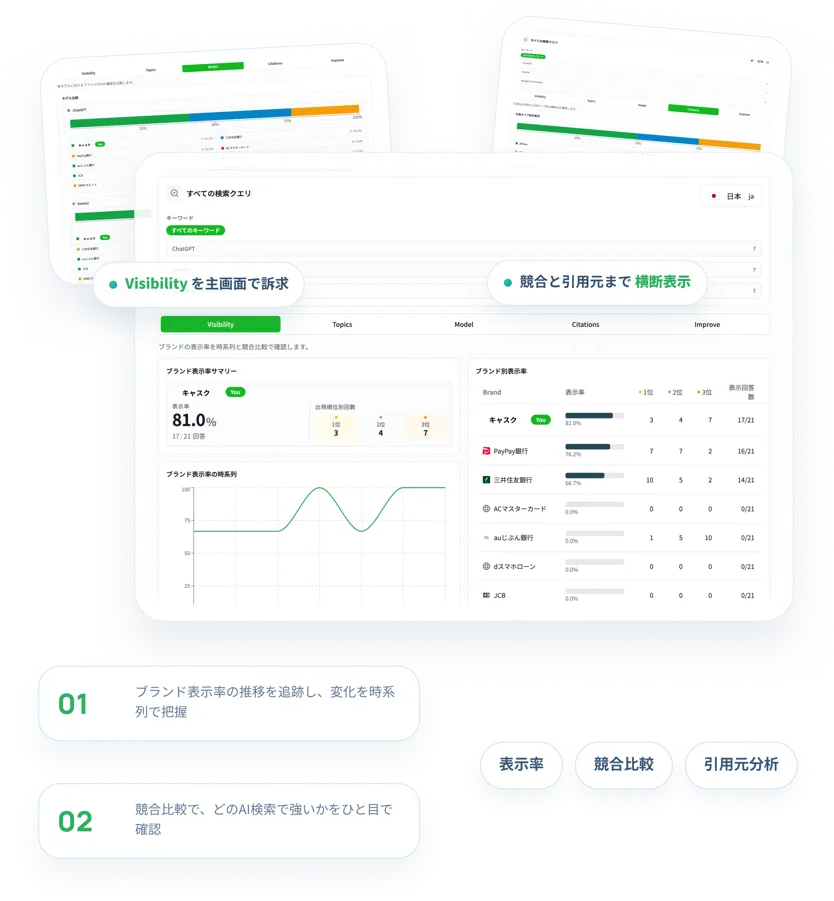
See how often your brand appears in AI answers over time, with direct competitor comparison.
Brand visibility trend
Brand visibility ranking
Business value
See which months and which models are lifting or suppressing your brand share.
Next Action
Identify the exact moment visibility drops and connect it to the next improvement target.
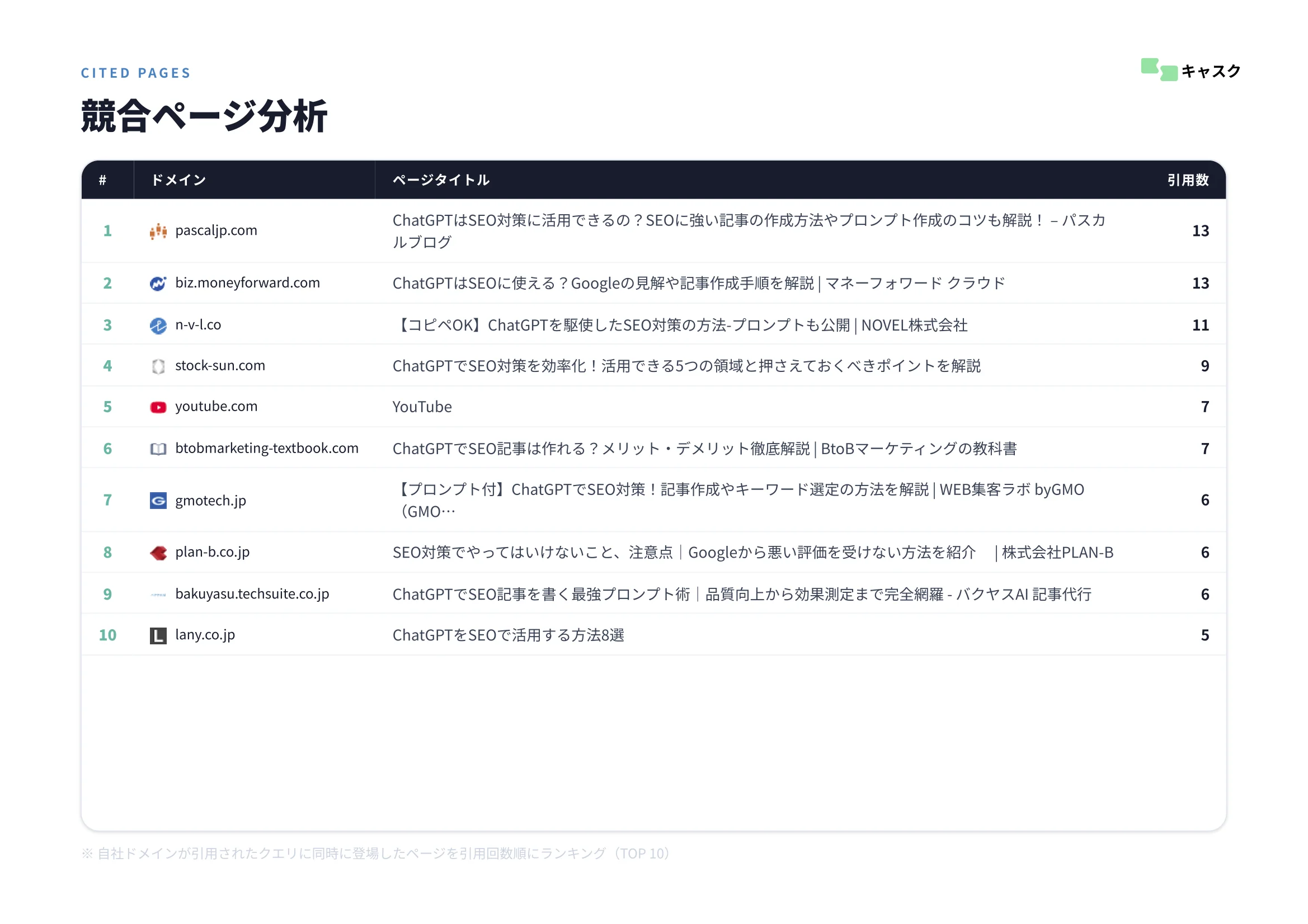
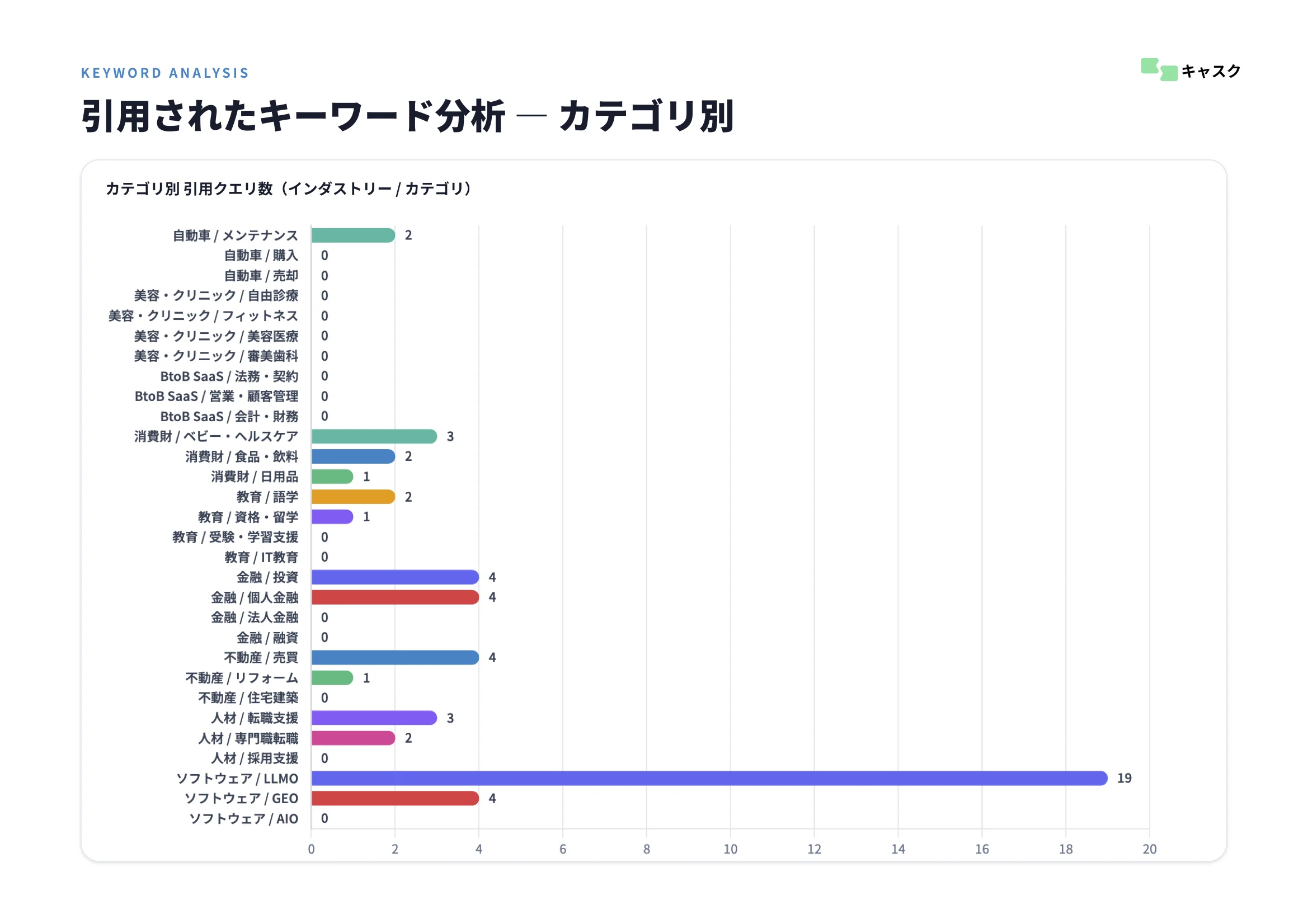
Aggregate source domains and pages behind AI answers, with owned, affiliate, and external breakdowns.
Citation mix
Top citing domains
#1 mybrand.com
#2 affiliate-a.jp
#3 external.com
Business value
Once you know which domains and pages get cited, channel investment decisions become obvious.
Next Action
Rebalance owned and external media strategy based on where citations are actually coming from.
Understand how AI talks about your brand through topic clustering and sentiment context.
Sentiment word cloud
Sentiment summary
Business value
Separate strengths from weaknesses using actual themes in AI answers, not guesswork.
Next Action
Start with the topics where negative framing is strongest, then reinforce FAQ and comparison structure.
Compare your share of voice across ChatGPT, Gemini, and Google AI Overview.
Share of voice by AI model
ChatGPT
ChatGPT still has room to grow
Gemini
Strongest position in Google AI Overview
Google AI Overview
Gemini gap is widening
Model takeaways
Business value
Instantly see where your brand already wins and where each AI model still has headroom.
Next Action
Defend the models where you lead and route weak models into the improvement queue.
Turn content opportunities into a ranked queue and inspect the source evidence behind each AI answer.
Priority pages
Strategy: Top-priority pagesTop priority page
Rework the play
Lift content quality
Low priority
Improvement queue
"Best ___"
#subquery A
"___ comparison"
#subquery B
"How to choose ___"
#subquery C
Evidence workbench
AI answer text
"This product stands out for value and an easy first-use experience..."
Citation match
mybrand.com/review
Score: 0.97 / Rank: #1 / Strengthening this page should increase citation probability
Business value
Prioritize execution with impact, reach, and potential instead of intuition.
Next Action
Start with the queue, then strengthen the source pages AI already trusts.
Audit your current exposure and identify the next high-impact actions in one flow.
Simulation
Input a URL or HTML and get an AI-generated optimization draft with a clear before/after diff.
FINAL SCORE
Run HTML capture, structure checks, and iterative scoring in one flow, then inspect the improved content immediately.
Content improvement pipeline (4 steps)
Normalize the target page into a parseable structure.
Split intent into actionable sub-queries.
Evaluate FAQ, heading, table, and list structure coverage.
Score and refine recommendations before final output.
Required structure checklist
How It Works
Standardize your AIO workflow from connection to impact tracking.
Register brand details, products, and target topics.
Continuously collect output and visibility data across models.
Inspect domains, pages, ranking context, and mention quality.
Apply high-impact content and structure improvements.
Validate outcome with Qask Pulse and analytics trends.
Before / After
Move from subjective reporting to a data-driven operating system for AI search visibility and improvement.
TEAM IMPACT
Reporting, prioritization, and competitor analysis happen in one dashboard, so teams can move faster.
Market Context
As AI engines answer directly, brand visibility can no longer be measured by traditional SEO alone.
Key takeaway
Most teams cannot monitor AI visibility, attribution, and competitor exposure with existing SEO tools.
The Shift
The Problem
The Opportunity
AI-driven search engines now generate direct answers, so users often never click through to a website.
Most teams cannot monitor AI visibility, attribution, and competitor exposure with existing SEO tools.
Early adopters can compound their advantage across fragmented AI engines.
Key takeaway
In the age of zero-click search, brands must be recognized to be found.
Key takeaway
AI search also needs a Search Console + GA4 analytics foundation for visibility
Key takeaway
Starting early creates a durable visibility lead.
Discover how your brand performs on AI engines — and uncover the opportunities to outpace the competition.
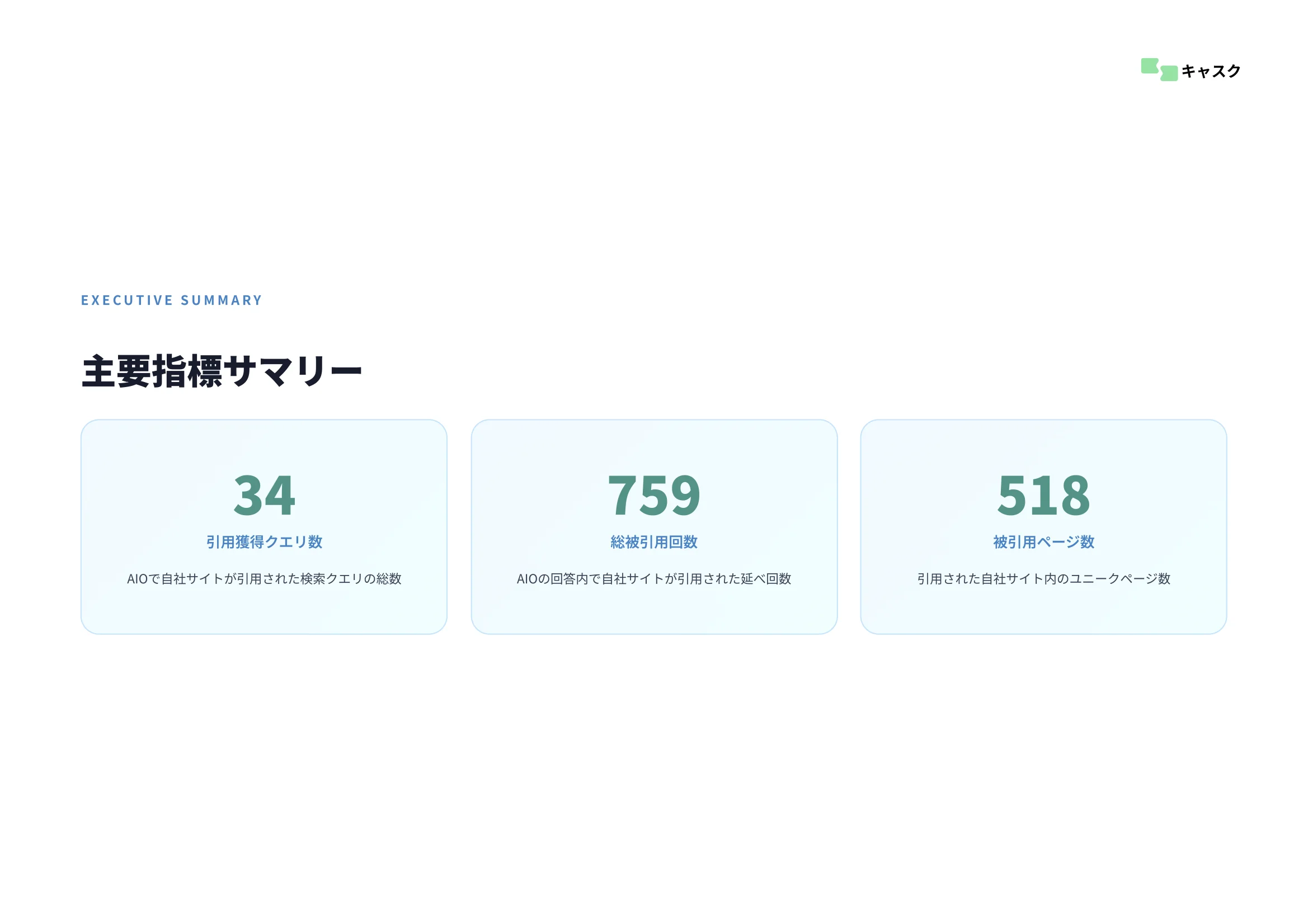
Get insights into:
We'll email it to you within 1 business day
Pricing
Perfect for getting started.
Ideal for Teams.
Tailored for teams.
Have questions about Qask? Here are the most common ones.
AIO (AI Optimization) is the next evolution of SEO. It focuses on optimizing your website and content so that generative AI systems—like ChatGPT or Google’s AI Overview—are more likely to cite your brand as a trusted source when generating answers.
Traditional SEO targets search engine crawlers and ranking algorithms. AIO, on the other hand, focuses on how AI models interpret context, credibility, and user intent—ensuring your content is structured and written in a way that AI systems can easily understand and reference.
As AI-driven search becomes the norm, users increasingly get answers directly from generative models without visiting websites. AIO ensures your brand remains visible and credible in this new landscape by being cited as a source in AI-generated responses.
AIO involves optimizing your content structure, metadata, and semantic clarity so that AI systems can accurately extract, summarize, and attribute your information. It combines SEO best practices with AI model understanding and entity-based optimization.
Marketers, content strategists, and brand owners who want to future-proof their visibility in an AI-driven search ecosystem—ensuring their expertise and authority are recognized not just by search engines, but by AI assistants as well.
Qask periodically queries major AI engines (ChatGPT, Gemini, Claude, etc.) with brand-related prompts and records the outputs, citations, and sentiment. This enables trend analysis over time and competitive benchmarking.
Based on tracking data, Qask suggests prioritized actions such as improving citation source content, enhancing FAQs, and updating official documentation—all aimed at increasing your brand's visibility to AI systems.
Initial tracking data is available immediately after setup. Improvements in AI engine outputs depend on the scope and nature of your optimizations, but continuous monitoring allows you to measure impact and iterate effectively.
Request a Demo